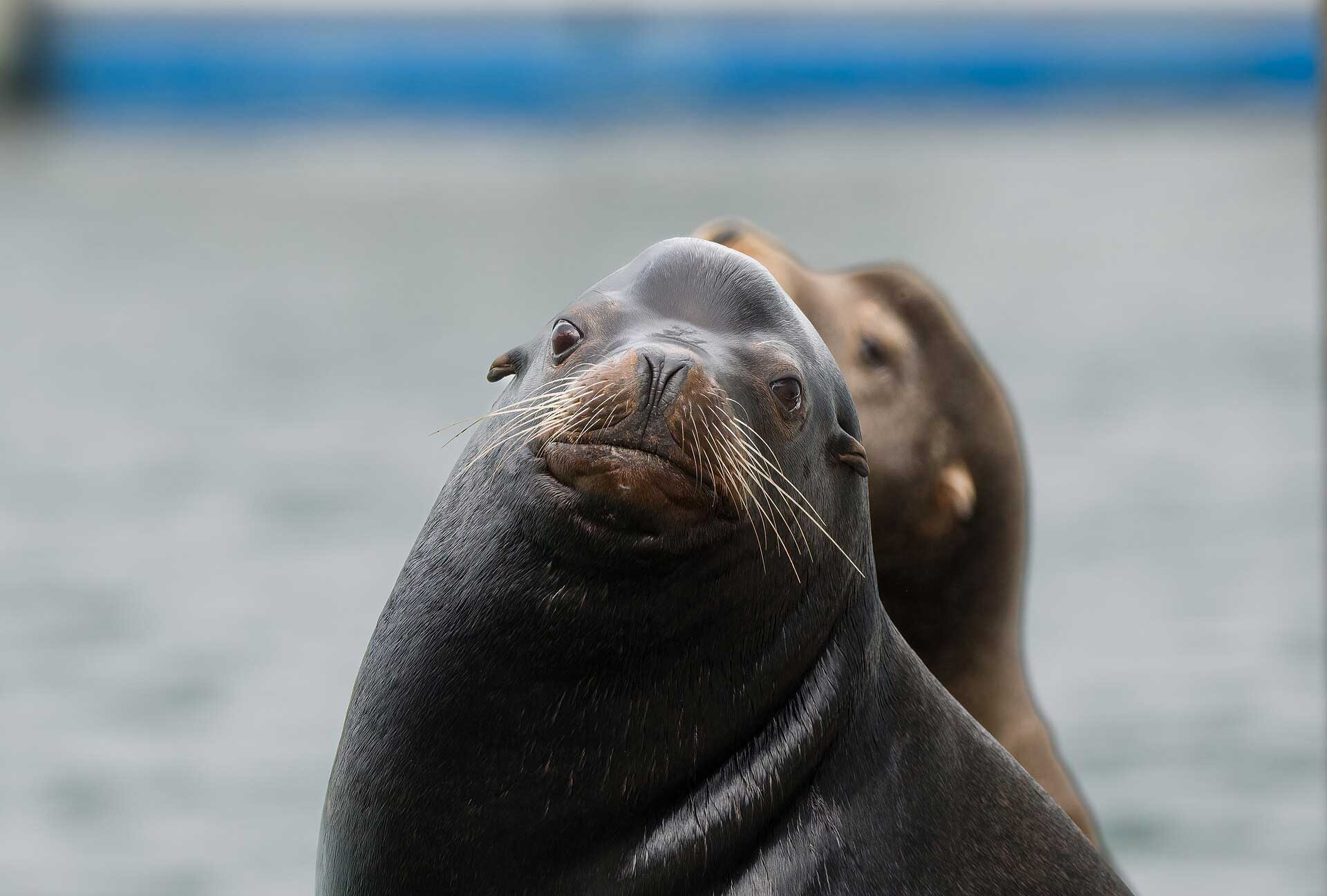
A face only a mother could love, currently taking up residence at Shilshole Bay Marina.
Photo: Jake Bonello / U.S. Fish & Wildlife Service. Source
Ballard's Loudest Houseguests: The Sea Lions of Shilshole
I stumbled onto something magical yesterday. Over 100 California sea lions have taken over the guest docks at Shilshole Bay Marina — barking, fighting, playing, and generally being a smelly nuisance to anyone within a quarter mile. It's chaotic, it's loud, and honestly, it's one of those rare moments where nature just shows up uninvited and reminds you who was here first. Standing there watching them, I couldn't help but wonder what this shoreline sounded like before Seattle existed — before the docks, the marinas, the condos — when this kind of spectacle wasn't a novelty but just a Tuesday.
If you haven't gone yet, go.
Why Are They Here?
This isn't a fluke. For the past four springs, Shilshole Bay Marina has been contending with droves of California sea lions occupying their guest boater moorages. What started as a spread across five finger docks has consolidated — this year they've claimed one large dock and made it entirely their own.
The short answer? Herring. Sea lions are not uncommon to Puget Sound, especially in winter, when males venture north from California in search of food while females stay behind to feed and raise their pups in southern breeding areas. Peak numbers at their traditional haulout coincided with herring spawning in March.
Marine scientist Scott Veirs, who chairs the Puget Sound Ecosystem Monitoring Program's marine mammal work group, puts it colorfully: the sea lions are chasing what he calls the "turducken of the sea" — herring so stuffed with eggs or sperm right before spawning that gorging on them is the highest-calorie move a sea lion can make.
Besides being formidable long-distance swimmers, sea lions are remarkable whisker predators. Blindfolded, they can still follow the path of a fish minutes after it has swum by — sensing subtle changes in water turbulence to track prey without needing light at all.
Their presence here is actually a conservation success story. The Marine Mammal Protection Act of 1972 helped California sea lion populations recover from decades of culling programs in the early 20th century. Combined with recent record-setting herring runs in Central Puget Sound, conditions have aligned to bring these marine visitors north in a role similar to what they likely played in the Salish Sea before settlers arrived.
There's also a wilder reason they've moved from the jetty to the guest docks specifically. The story goes that in 2023, live-aboard residents at the south end of the marina were woken in the middle of a windless night by their boats rocking and killer whale calls echoing through their hulls. The next morning, evidence suggested a killer whale had eaten at least one sea lion near the jetty. Veirs' hypothesis: that was disturbing enough to send them looking for safer harbor.
Most of the visitors are California sea lions, but Veirs has also identified Steller sea lions among the group — larger, stockier animals that are blonder in color and produce deeper, more guttural sounds. "Instead of barking, there's this much more deep, almost terrifying, guttural growling going on," he said.
Don't expect them to be easily moved. Sound-emitting devices placed on the docks when they first arrived did nothing to deter them. And yellow caution tape — let's be honest — is not going to stop a 600-pound sea lion from going anywhere it wants. It's really just there to remind the humans to keep their distance. By early June most years the sea lions have moved on and the boats return, but Veirs notes they have excellent memories for productive feeding spots. This annual pattern may become the new normal. Don't be surprised if they're back next spring, a little more comfortable and a little harder to move.
Barking Comeback: Sea Lions reflect resilience of Puget Sound ecosystem — FOX 13 Seattle, June 2025
Source: Puget Sound Institute — "Follow the herring: Why sea lions have been calling Shilshole Marina home"
I've Been Here Before — Sort Of
In 2005, I was on Espíritu Santo — a remote, protected island in the Sea of Cortez off La Paz, Mexico — on a day tour. As we rounded a certain cove, our tour guide got very serious. What followed was less a safety briefing and more a carefully delivered legal disclaimer — the kind of speech that's really saying "if something goes wrong, I told you so, it's not our fault, and please don't sue us." Never get between a mother and her pup. These animals can be aggressive. The risks are real. She hit every note with the practiced calm of someone who had given this speech many times and wanted it on the record. By the time she finished, half our group had decided the boat was a perfectly fine place to spend the afternoon.
Those of us who got in the water found something completely different.
The sea lions weren't threatening. They were playful — frolicking around us like they were genuinely delighted to have company. It's one of those moments that reframes everything. The danger was real, the warnings valid. But the experience was pure joy.
I thought about that yesterday, watching the chaos at Shilshole from the dock. Same animal. Completely different context. Worth remembering both.
Isla Espíritu Santo, Sea of Cortez, Mexico — a UNESCO Biosphere Reserve unlike anywhere on Earth outside the Galápagos
⚠️ What You Should Know Before You Get Close
A sea lion encounter at Shilshole can look harmless — they're mostly just barking and flopped on the docks. But if one bites you, it is a medical emergency. These are 600–800 pound predators with immense jaw pressure and a mouth full of bacteria your doctor may not be prepared for.
The Specific Danger: "Seal Finger" (Pinniped Mycoplasmosis)
This is an aggressive infection caused by Mycoplasma bacteria — unique to pinnipeds — that causes severe swelling and can lead to permanent joint stiffness or even amputation if treated incorrectly. Standard antibiotics like amoxicillin don't work. You need Doxycycline or Tetracycline specifically.
If you're bitten:
- Seek emergency medical care immediately.
- Request treatment for Mycoplasma specifically — standard antibiotics won't cut it.
- Monitor for red streaks, fever, or discharge for 7–10 days.
- Because this is Puget Sound, wounds can also carry secondary marine bacteria like Vibrio or Pasteurella, which cause rapid-onset cellulitis.
The law: All sea lions are protected under the Marine Mammal Protection Act. Feeding, touching, or harassing them is illegal. The yellow caution tape at Shilshole isn't decoration — respect it.
"Being bitten by an adult sea lion is like being bitten by a bear — plus their mouth bacteria are really awful, like flesh-eating bacteria." — Scott Veirs, marine scientist, Puget Sound Ecosystem Monitoring Program
Watch from a respectful distance. The show is good enough from there.
Coming Home to Their World
There's something different about seeing a wild animal up close that no zoo or nature documentary can replicate. At a zoo the animals are guests in our world — fed on a schedule, safely behind glass, performing existence for our entertainment. At Shilshole it's the opposite. We are the visitors. The sea lions aren't there for us — they're there because the herring are running, because the water is cold and deep, because this coastline was theirs long before anyone drew a city around it. Standing on that dock, surrounded by the noise and the smell and the sheer indifference of 100 wild animals going about their lives, you're reminded that Seattle — for all its coffee shops and condos and tech campuses — is just a thin layer we've placed over something much older and much wilder. That's worth stepping outside for.